Down to the second: how Translink uses Ask Mosaiq to tackle early running and boost driver performance
See how Translink's Systems Performance Manager uses Ask Mosaiq to resolve network questions fast and track driver performance down to the second.

See how Translink's Systems Performance Manager uses Ask Mosaiq to resolve network questions fast and track driver performance down to the second.
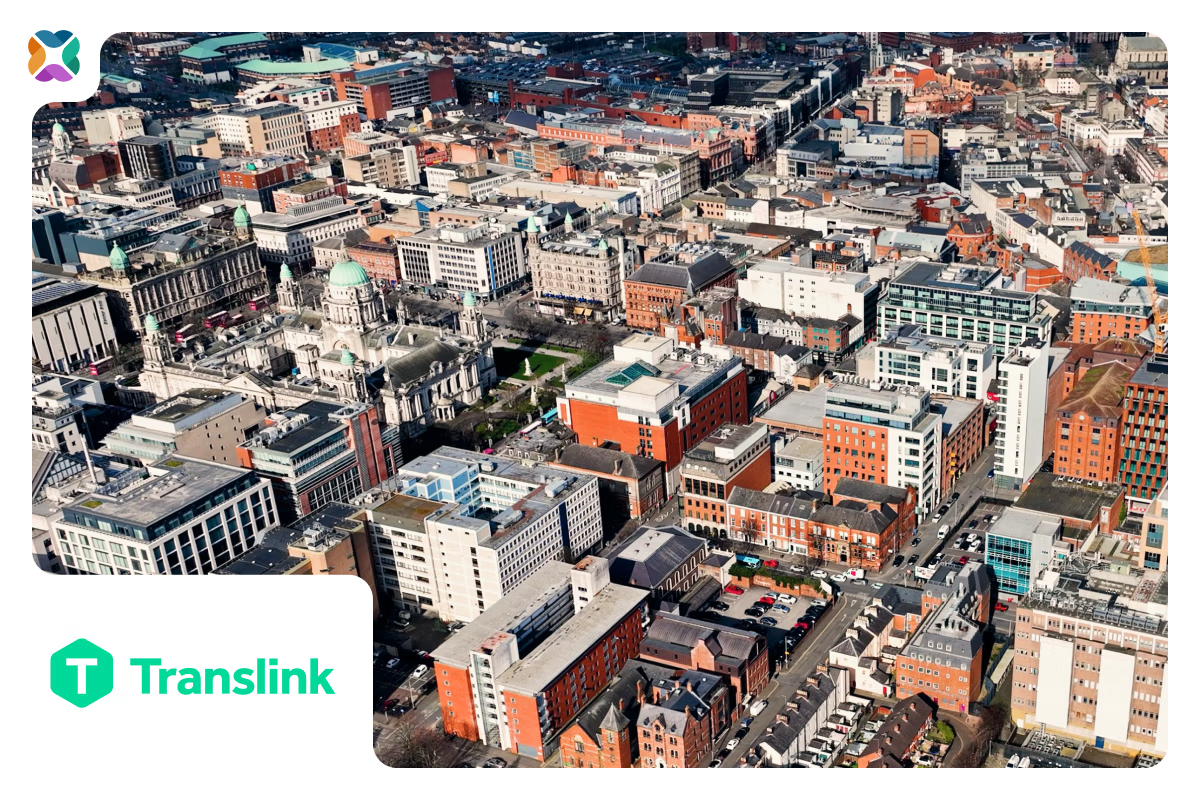
Translink runs public transport across Northern Ireland, with around 1,400 buses delivering approximately 68 million passenger journeys in the last year. Having used the Mosaiq Transit Intelligence Suite by Snapper Services since 2023, Translink was one of the first operators to start questioning its network directly with Ask Mosaiq.
Brian Montgomery (BEM) started as a bus driver in Belfast and has since become the depot’s Systems Performance Manager. Now, Brian uses Ask Mosaiq to tackle early running at its source and uncover the reasons behind anomalies in the network.
Translink NI at a glance
Early running occurs when a bus leaves its stop ahead of the timetable. Many operators and authorities outline an “on-time window” for a stop, which may be anything from a minute early to 5 minutes late.
However, departing even less than a minute early is not always satisfactory. There is no point to a timetable when a bus is not at a stop as expected.
"Early running has always been a significant concern for us (as with any bus company) because it directly impacts customers and their confidence in the service.
From a passenger perspective, a bus arriving early can be more frustrating than one arriving slightly late because customers can miss their service altogether, even when they arrive at the stop on time according to the published timetable."
For Brian, tackling early running is a top priority. But before Ask Mosaiq, even finding it took serious effort.
"Before Ask Mosaiq, identifying early running was a very manual and time-consuming process. We could see overall punctuality trends, but it was difficult to consistently pinpoint exactly where and when early departures were occurring. This meant that issues could remain hidden within wider performance statistics."
His team spent "considerable time gathering information from multiple systems" before they could even begin to investigate why a service had left early.
And without a simple way to trace early departures back to individual drivers, Brian couldn't tell whether the fault lay with the timetable, the route, or individual habits behind the wheel. Answering that, and answering it with evidence, is where Ask Mosaiq came in.
To get to the root of early running, Brian needed to understand driver behaviour. Mosaiq Insights doesn't hold driver information directly, but it does record the unique vehicle ID and departure time for every trip. Translink keeps its own record of which driver drove which bus.
Working with our Customer Success team, Brian found he could connect the two. He asks Ask Mosaiq for the vehicle IDs and departure times behind early-running trips, then matches them against Translink's internal driver records. Driver data never leaves Translink's systems.
The result is a level of detail Translink hasn't had before.
"The biggest change is that conversations are now evidence-based rather than perception-based. Previously, discussions might have been driven by customer complaints or general observations. We can now look at specific departures, locations, times, and patterns and have much more objective conversations."
On one route, Brian's team found a small number of departures consistently leaving a timing point early.
"Rather than approaching the issue in general terms, we were able to show the exact journeys, dates, and departure times. This helped move the discussion away from opinion and towards understanding the operational factors contributing to the behaviour."
Evidence down to the second means managers can focus on:
"As a result, conversations with drivers and local management teams have become more constructive. The focus is on improving customer experience and timetable adherence rather than debating whether an issue exists."
Brian sums this new capability up: Ask Mosaiq is "absolutely amazing" and "a godsend."
With every early departure traceable, Translink could finally test where the problem lay. The answer pointed away from the schedule.
"It has focused our efforts on particular areas where early running has occurred and proved that generally our schedules are not the problem but that early running is caused by different factors like driver behaviours and differing traffic trends."
That means Translink can direct its effort at driver support and traffic patterns, instead of reworking timetables that already work well.
Ask Mosaiq objectively flags issues in the network that users may otherwise miss due to familiarity. Reviewing problems on the network one week, Ask Mosaiq surfaced two stops one service wouldn't normally operate through.
"I said to myself, 'no, that's wrong,'" Brian recalls.
So he asked Ask Mosaiq to confirm whether the 2A and 2D had served Oxford Street and St George's Market. They had. Ask Mosaiq identified them as alternative stops in use during the week commencing 7th August: Fleadh week, when Brian estimates 1.6 million people came through Belfast.
"In actual fact, that was a scheduled reroute via temporary stops that we put up."
Without Ask Mosaiq, the reroute would have gone unnoticed, and Brian would have struggled to explain the stop data to his Service Delivery Managers (SDMs).
"I wouldn't have picked up on that, because we would have just gone to the next week and the next week all the services would have been back on their normal route. So Mosaiq actually brought that out to me and raised the question in my head."
That's how Ask Mosaiq is designed to work. It answers from your network data, shows its evidence, and leaves the final judgement with you.
The biggest change hasn't been a single report. It's how Brian approaches his data.
"Ask Mosaiq has allowed us to move beyond simply asking whether a route is performing well or poorly."
Those sharper questions have paid off in time saved, too.
"The ability to ask these kinds of detailed questions has significantly reduced investigation time. We can now focus our efforts on the areas where corrective action will have the greatest impact."
Every early departure avoided is a passenger who doesn't miss their bus. By linking network performance to the people delivering it, Translink can support its drivers more fairly and run a more reliable service for Northern Ireland.
It's fitting work for Brian, who was awarded the British Empire Medal for keeping Northern Ireland's buses on the road through the pandemic. Today, he's using Mosaiq to keep them running on time.
Tackling early running yourself? These are the questions Brian now asks Ask Mosaiq:
Ask Mosaiq works with vehicle IDs, not driver details. To look at driver patterns, match vehicle IDs against your own driver records, as Translink does.
Ask Mosaiq is available in Mosaiq Insights, included on the free plan. Ask your first question today.
Let one of our team show you how we can help improve your transit network with Mosaiq. Set up a comprehensive, personal introduction for you and your team today.

Catch up on the latest Mosaiq news, industry updates, and thoughts from the team.