A must-win bid, in a competitive public transport market
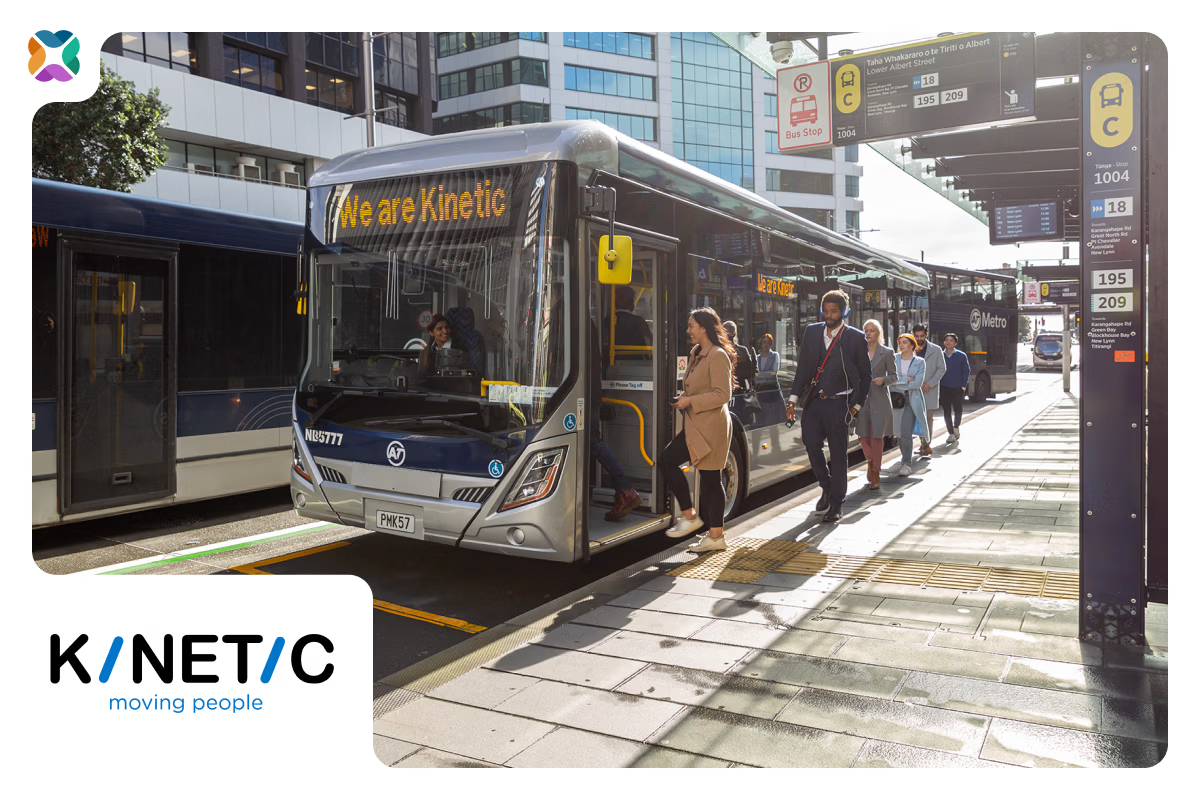
Kinetic is New Zealand's largest bus operator, with a centralised Operations Control Centre that spans multiple regions, providing real-time oversight of network operations, and dedicated network planning and commercial teams.
Auckland Transport's (AT) Tranche 3 tender covers parts of central and eastern Auckland,New Zealand's largest city – equalling a peak vehicle requirement (PVR) of approximately 225 across four contract units. Of those, the majority were defensive: routes Kinetic already operated and wanted to retain.
Paul Marr, Commercial Analyst, plays a key role in supporting tendering and procurement for Kinetic's New Zealand business. He is clear about what the bid represented:
“It was a highly defensive tender. The whole team was focused on it.”
The commercial backdrop raised the stakes further. The new generation of PTA (Public TransportAuthority) contracts across New Zealand carry significantly stricter Key Performance Indicator (KPI) regimes than incumbents had previously operated under. Therefore, the ability to monitor performance, identify issues proactively, and build an evidence base to support performance discussions was no longer a nice-to-have; it was crucial to Kinetic's success under the new contracts.
To win this bid, against new and old competitors, Kinetic required more than an operational track record. They needed to present a compelling, evidence-backed case for what they would deliver next.
Paul had to ask: “What tools could help us better manage the network and give us greater visibility of performance?”
The problem: data all over the place
Before Kinetic engaged Mosaiq, their operational data picture was fragmented. Feeds from Auckland Transport, vehicle tracking through their own eRoad system, and scheduling data all sat in separate tools. Useful information existed; it just lived in different places.
For Kinetic's Operations Control Centre team, which manages more than 5,000 trips a day, that fragmentation created real friction. If a vehicle appeared on an unexpected route, tracing it back to the right duty, depot, and driver meant moving between multiple systems – no simple task when you're operating at that volume and pace.
Paul describes the broader challenge: “We have data feeds, but they're kind of all over the place – little snippets of data over here, a bit over there.”
What Auckland Transport was looking for
Auckland Transport wasn't just evaluating price. They wanted to see operators demonstrate that they could manage networks efficiently and accurately, and that technology would be central to how they did it.
Paul sums it up: “AT had a very high preference for technology solutions. They're looking at operators that can support a network and do that through technology and do thate fficiently and quickly and accurately.”
For Kinetic, the question became: what could they credibly commit to, and how could they back those commitments with evidence?
Mosaiq: one source of truth
Kinetic was looking for a solution that could evolve into a central operational hub – something scalable across regions, web-based, easy to roll out, and, critically, capable of integrating multiple data sources. They also wanted a provider willing to develop the product alongside them, not just hand overs oftware and step back.
“We really wanted something we knew we could not just take up in Auckland but potentially take up across the country,” Paul says.
What distinguished Mosaiq Insights in that evaluation was a combination of factors:the platform already integrated with AT data, the team had demonstrable experience across New Zealand PTAs, and – importantly – they showed genuine interest in where Kinetic wanted to go.
“Jai, our Mosaiq Account Manager, has been amazing to deal with. Very approachable and easily contactable. He did a really good job of talking through Mosaiq's willingness to work with operators and develop the system.”
Just as important, Mosaiq isn't only a tool for the control room. It can be used by multiple teams across Kinetic – from planning and scheduling to commercial and other support staff – so everyone works from the same picture.
“We've got teams across planning, operations and the support office, and they all find it very easy to get around Mosaiq. When you've got that many different functions using the same system, ease of use really matters.”
Writing Mosaiq into the bid
AT required operators to demonstrate their technological capability as part of the bid process. Kinetic named Mosaiq as one of the technology solutions it intended to implement, clearly outlining what it would deliver.
Paul reflects on why that mattered:
“That gave us a lot more confidence to give evidence that we've got tools that we're going to implement... and we know that it will work for what we're stating.”
Including a named, proven solution strengthened Kinetic's proposed technology approach and provided greater confidence in how those technology commitments would be delivered.
"You've got a very powerful tool that's leveraging a large amount of data, but it's all in one place."
What Mosaiq helps Kinetic do
Fundamentally, Mosaiq supports better-informed decisions in two ways.
One view of service delivery performance
With vehicle GPS data and scheduling data integrated into Mosaiq alongside AT feeds, performance is visible in one place, presented in a way that's easy to understand. At scale – more than 5,000 trips a day – that matters. It also gives Kinetic an independent, operator-controlled evidence source that can be used to verify operational performance where required.
Paul explains the value:
“It gives us an independent source of data to verify operational performance and support conversations with Auckland Transport when needed.”
Network planning and service improvements
Runtime analysis lets Kinetic's teams pinpoint where a route has a timing issue – and exactly where on the route it's happening – supporting timetable reviews and adjustments that matter for both service delivery and commercial performance.
Auckland Transport's verdict
The contract was awarded to Kinetic in March 2026. All four Tranche 3 units, valued at $755 million, for terms between 8 and 11 years – Kinetic's largest Auckland contract to date.
In the feedback sessions AT held with all bidders following the award, the technology solutions Kinetic had proposed were specifically highlighted.
Paul notes the significance of the callout:
“Usually you find that the things a PTA will comment on – the fact they're commenting on them means they've been a reasonably important part of the decision making.”
What comes next
Winning the bid was the beginning. As Kinetic moves into mobilisation – with the first contract going live in December – Mosaiq's runtime analysis capability will become central to how its planning and performance teams prepare for AT's post-award review, a process where AT assesses network performance in the first three to six months after go-live.
“The runtime analysis piece is going to be really valuable,” Paul says.
“Our planning and performance teams can pick out, look, this route's got a runtime issue, and it's happening between this point and this point. They've got the information they need to work with Auckland Transport and say: we know this route has a runtime issue – let's have a look at the timetable.”
Getting ahead of that process – rather than reacting to issues identified – supports a more proactive approach between operator and authority.
Post go-live, KPI and performance management is the capability Paul expects to lean on most. Not just for performance monitoring, but for building the evidence to support performance discussions and contest penalties where appropriate, and for internal accountability at route and driver level.
Kinetic also has Mosaiq Live available as they look further ahead, with disruption management a key use case on the horizon – pre-emptively rerouting buses when road incidents are detectede arly, before vehicles join queues they can't escape.
One system. One source of truth.
The main benefit of Mosaiq?
“Having all our data in one place, presented in a way that's easy to understand,” Paul says.
“Data is obviously such an important part of any business now. To have technology providers that can flex and work with you as your data requirements might change – that's the thing.”
Paul also looks forward to working with the team as Mosaiq evolves:
“Mosaiq understands what operators and PTAs are trying to achieve, which is a big plus against other applications without that industry knowledge. The Mosaiq team has been very willing to listen to what we're trying to achieve and support that.”
What Mosaiq gave Kinetic wasn't just another application platform to implement. It has become an important part of Kinetic's broader technology approach, and a platform the business expects to continue building on as its operating environment evolves.
Kinetic is the largest bus operator in Australasia and a leading multi-modal mass transit operator globally through its subsidiary Go-Ahead. At mobilisation for Tranche 3, they'll deliver the largest single roll-out of zero-emission buses in New Zealand. Paul Marr is Commercial Analyst and part of Kinetic New Zealand'sCommercial Leadership Team.