But dig a little deeper, and the two networks tell diverging stories – with very different opportunities for improvement.
Portugal's problem: running late
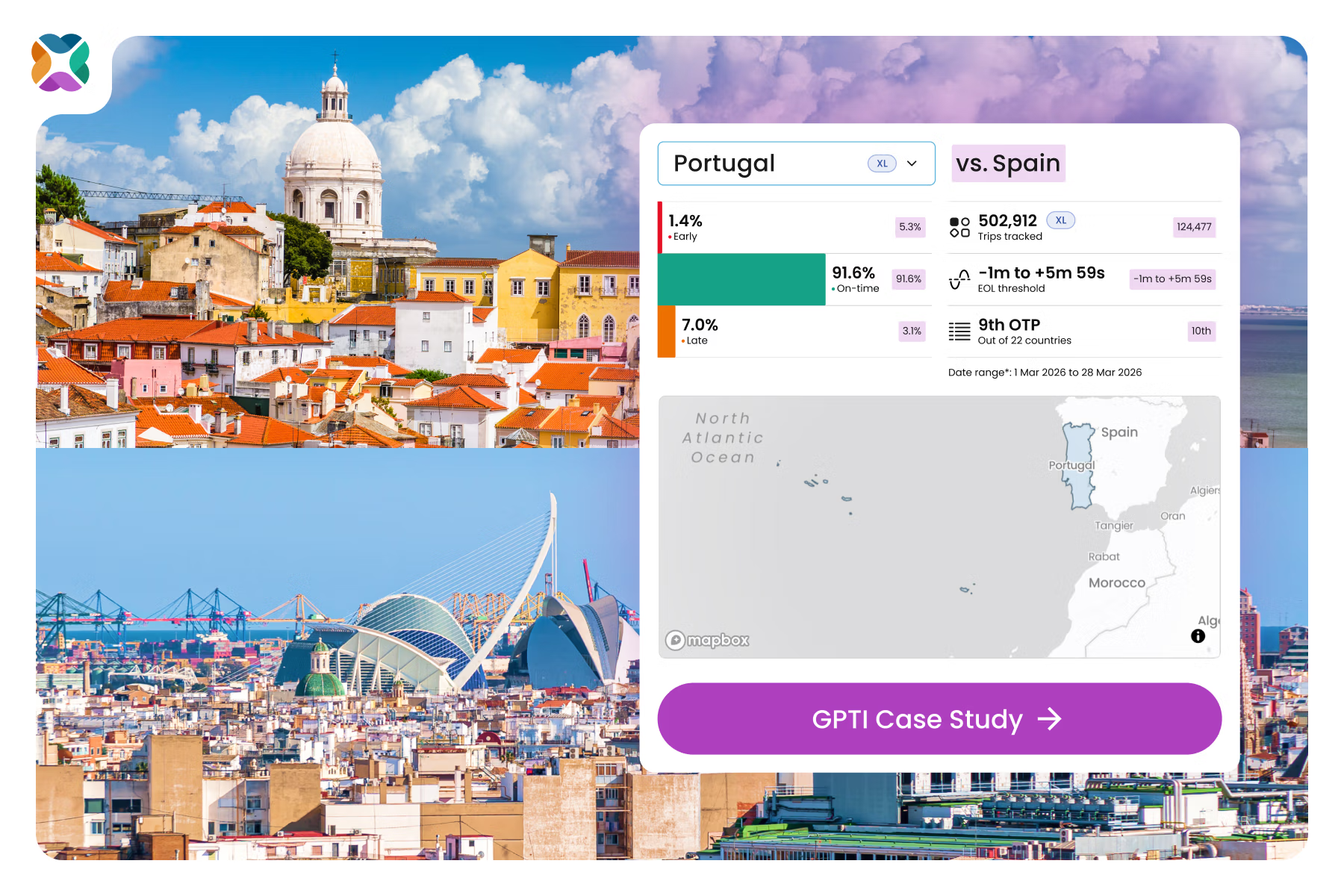
Portugal's biggest challenge is lateness. A full 7% of its bus trips arrive behind schedule, more than double Spain's late-running rate of 3.1%. That's a meaningful gap, and its causes aren't hard to find.
Portugal is one of the countries in the EU with the least people using public transport: 67.8% of citizens didn’t use public transport at all in 2024. People still prioritise private travel in cars: in Lisbon, more than 390,000 cars hit the roads each day – 20,000 more than eight years ago.
But Portugal's public transport landscape is changing. Since 2024, ridership has been growing, with national bus agency Rede Expressos transporting more than 12.5 million passengers in 2025, a year-on-year increase of 9%. Lisbon, the country’s capital, has also seen a surge in bus passengers, with 19 million in October alone.
This increased demand is putting pressure on existing infrastructure, which will require upgrades to cope with current and future demands. The country is also recovering from three back-to-back storms that hit in early 2026, causing deaths and damaging infrastructure, including roads and rail.
Meanwhile, experts have criticised Portugal’s prior decisions to decrease fare costs without increasing transport supply, which risks reducing physical access, crowding, and potentially driving down network reliability.
When demand outpaces capacity and roads are busier than timetables were built for, late running is the predictable result.
Spain's problem: leaving too early
Spain's challenge is a different but equally problematic one: 5.3% of its trips are arriving early – possibly before passengers have reached their stop, preventing them from boarding at all. Only 3.1% are late.
This pattern may reflect overly conservative scheduling. When timetables are padded with buffer time to guard against delays, buses can sail through quieter stretches and arrive ahead of schedule, leaving would-be passengers behind.
Early departures are easy to underestimate asa problem. But a bus that leaves two minutes early is, from the passenger's perspective, a bus that didn't show up. Ultimately, your reliability has taken a hit.
How do they stack up globally?
91.6% sounds like a strong score for both countries – until you look at who's ahead. In the GPTI's country rankings, both Portugal and Spain sit in 9th and 10th place out of 22 countries worldwide.
The leaders – Finland (97.9%), Czech Republic(97.1%), and Lithuania (96.4%) – aren't necessarily richer nations (for example, Spain has a GDP approximately 20 times the size of Lithuania’s), but they are achieving better on-time performance.
Finland and Czechia have a high proportion of their citizens using public transport, with only 28.8 and 31.8% of their populations never using public transport in 2024, respectively. This is in contrast to Portugal, where the bulk of citizens hadn’t taken public transport that year.
Lithuania and Spain tell a slightly different story, and imply that the proportion of citizens using public transport doesn’t necessarily mean better public transport performance. In Lithuania, which has an on-time performance that is 4.8% higher than Spain, fewer people take public transport (42.1% never took public transport in 2024 compared to 38.4% in Spain).
Two countries, two fixes
The data suggests a clear direction for each network:
For Portugal, the priority is building fleet and infrastructure capacity. Years of austerity after a 78 billion euro bailout from the IMF meant neglect for public assets.
While Portugal’s finances are rebounding, merely putting more buses into the network won’t solve their reliability issues. Tactics like increasing fleet size must be implemented alongside reviewing schedules, creating bus priority lanes and resisting the urge to cut services that are struggling – since cancelled routes tend to accelerate the "reliability death spiral" of falling ridership and reduced funding.
In Lisbon, Transportes Metropolitanos de Lisboa is considering electric buses, digital payment and information systems, and bus priority lanes to help their networks run more smoothly.
For Spain, the opportunity lies in revising buffer times, especially at journey starts when drivers trip on. This is a delicate balance to reduce early departures without sacrificing the overall reliability that Spanish operators have worked hard to build.
What the GPTI makes visible
What's striking about this comparison is how easy it would be to miss entirely. An identical headline OTP figure suggests two equivalent networks. But the GPTI's breakdown of early arrivals, late arrivals, and on-time performance by route and operator reveals the very different dynamics at play beneath the surface – and with them, the very different levers each country can pull.
Curious how your network compares? Explore the free Global Public Transit Index and see where your buses really stand.
Want to improve your network? Snapper's Mosaiq and Optibus’ Performance Suite work together to help operators and authorities move beyond static schedules and reactive fixes – so you can continually improve and see real operational outcomes.
Open data sources: The Mosaiq Global Public Transit Index uses publicly available transit schedules and real-time “open” data from locations worldwide. We acknowledge Mobility Database for championing open data globally.



.png)